
Release Notes – Version 4.3.0
A/B testing has always carried a quiet cost: while the test runs, a fixed share of your visitors sees the losing variant. Version 4.3.0 removes that cost. New tests now run as multi-armed bandits, shifting traffic toward the likely winner while the experiment is still live, and the whole experiment loop, from create to applying the winner, now runs end to end through the abilities API, so an AI agent can run a test without a human in the editor. Alongside it: engaged-time tracking that measures attention rather than arrival, a top content tile that answers "what's working today" at a glance, a clearer split between the Dashboard and a dedicated Content Explorer, and a hardened Abilities API that gives AI agents exact data or a clear error, never a silent guess.

Tests that stop wasting traffic on the loser
A classic A/B test holds its split fixed from start to finish, which means a variant that pulls ahead on day three still only gets half the traffic. New tests now allocate traffic with Thompson Sampling: the better a variant performs, the more visitors it earns, while guardrails keep the test statistically honest.
- Burn-in first: every test starts with an even split until enough conversions accumulate, so early noise can't hijack the allocation.
- Traffic follows the evidence: as confidence builds, allocation shifts toward the leading variant. A floor keeps every variant in play and a cap stops a runaway leader from starving the test of information.
- A clean final reading: once a variant reaches the 95% probability threshold, the split returns to even for a confirmatory phase before the winner is declared. The numbers you act on are unbiased.
- Nothing changes mid-flight: tests already running keep their existing behavior, and a filter switches new tests back to classic even-split if you prefer it.
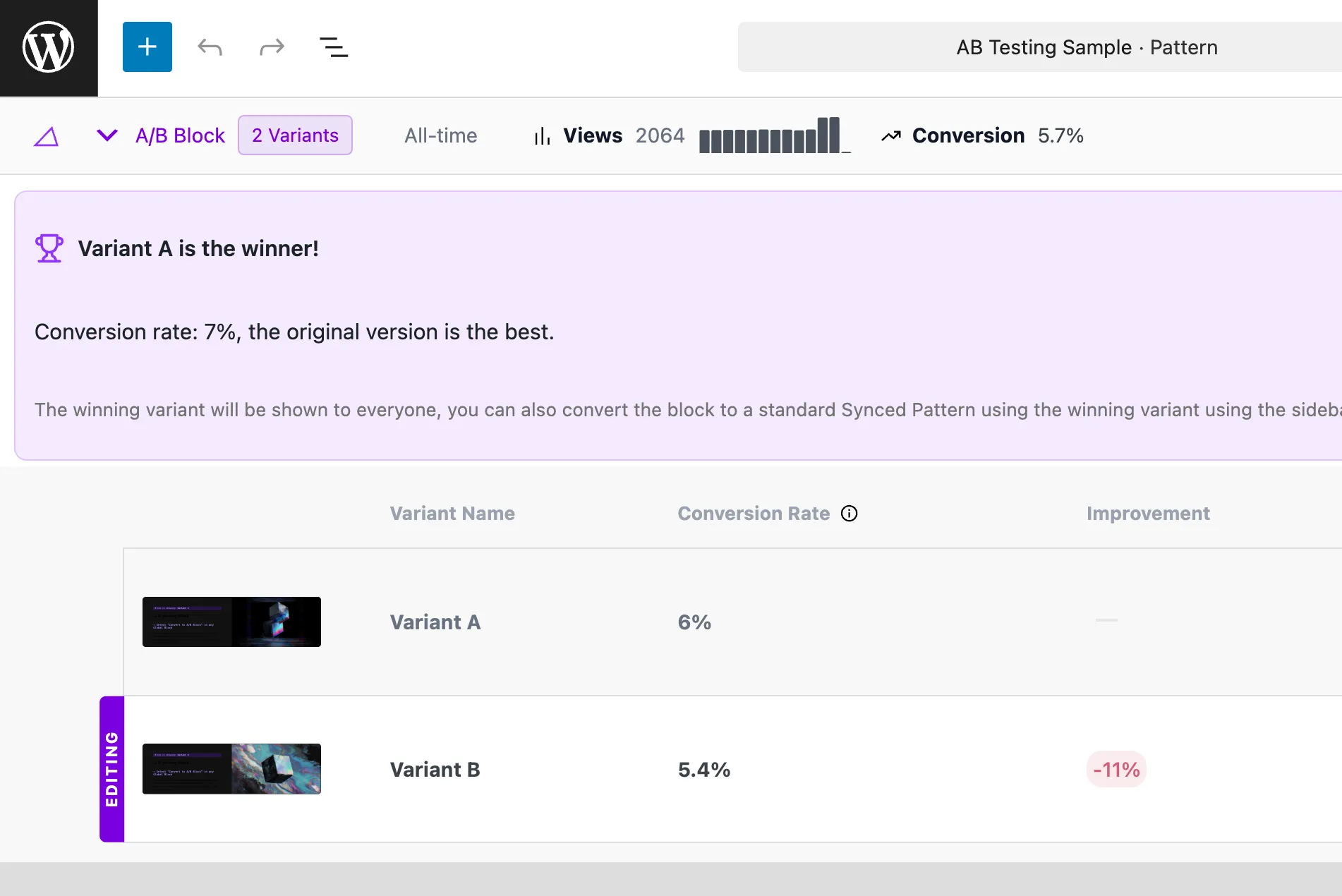
An A/B test an agent can run start to finish
Bandits decide how to split the traffic. The abilities API now handles everything around them: a tool like the Accelerate AI Toolkit can create a test, start it, read live results at every phase, and apply the winner: the complete loop, over MCP, with no one touching the editor.
- The full lifecycle: create, start, live results through the burn-in, bandit, and confirmatory phases, the leading variant's probability to win, and the winner served at 100%, then a clean slate for the next test.
- Know what made each test: experiments now carry their origin, so the overview shows at a glance which tests an agent created and which you set up by hand.
- Name your experiments: tests created through the API take their own title, so a stack of rounds on the same block reads as distinct rows instead of repeating the block's name.
Engaged time: attention, not arrival
Page views count events. Engaged time measures whether anyone actually read the thing. A post with 10,000 views and 8 seconds of attention is underperforming; a post with 800 views and 4 minutes is worth doubling down on. Accelerate now tracks the difference.
- Real engagement, not elapsed time: time only accrues while the visitor is actively reading, scrolling, or interacting. A tab left open overnight counts for nothing.
- In the dashboard: engaged time reads as a ranked breakdown, which posts actually hold attention, alongside referrers and outbound clicks, each figure formatted the way you'd say it out loud: "4m 32s".
- Opt-in, sampled, private: off by default, with a sampling rate you control. No new personal data is collected, and tracking respects the same consent decisions as everything else.
- For your agents too: engaged seconds, engaged sessions, and average engaged time per visit are now part of the engagement metrics ability, so "which posts hold attention" is a question AI can answer.
Your best content, first
A new Top Content tile leads the dashboard's breakdown panel, answering the first editorial question of any day: which posts are driving traffic right now. It sits alongside referrers, campaigns, and outbound clicks, so the full story of a visit reads in one row.
- Ranked by the active period: today, yesterday, or any window you've selected, with the same proportional bars as its neighbors.
- Live in realtime: in realtime mode the ranking re-orders as traffic moves, on the same refresh cycle as the rest of the dashboard.
A clearer split: Dashboard and Content Explorer
The admin now draws a clean line between watching your site and digging into it. The dashboard is the dashboard (KPIs, traffic chart, and breakdown panels), and the full content data table moves to its own Content Explorer page at the top of the menu.
- A tidier dashboard: the KPI tiles (unique visitors, page views, and the rest) sit on a single row, and the breakdown panels read consistently with the Analytics page.
- Content Explorer on its own: the content table gets a dedicated page instead of living at the bottom of the dashboard.
- Still optional: the takeover toggle turns the whole dashboard on or off cleanly, exactly as before.
A stricter Abilities API
AI agents are only as good as the data they're handed. Every one of the 41 abilities is now strict about what it accepts and precise about what it returns, so an agent working your analytics gets exact data or a clear error, never a silent guess.
- Exact date ranges: every query is scoped to precisely the window the agent asked for, whether that's the last 7 days or a specific fortnight.
- Strict inputs: unrecognized parameters are rejected with a clear error, so an agent's typo surfaces immediately rather than skewing an analysis downstream.
- Leaner payloads: zero-count rows are dropped and verbose responses trimmed, so agents spend their context window on signal.
- Richer metrics: unique visitor counts across the post performance and author abilities, and engagement responses that include the new engaged-time data.
- Read the whole site: two new read abilities (raw block markup for any post or pattern, and a media-library listing with alt text and dimensions) let an agent ingest a site's full design grammar instead of a 30-word excerpt.
Other Improvements
- Analytics without the takeover: the Analytics page stays available even when the dashboard takeover is switched off.
- Change an audience anytime: a personalization variant's audience can now be edited after it's set: reopen the picker from the variants table whenever targeting changes.
- New experiment fields: the REST API exposes read-only test mode and phase fields so integrations can see where a bandit test stands, and result counts come back as integers.
The bandit work has been on the list for a long time. Watching a test shift its own traffic toward the winner doesn't get old. We'll see what yours does.